
Estimated reading time: 15 minutes
I traveled to Machu Picchu from Cusco in March-April during shoulder season — this guide covers the full journey firsthand, including how we bought tickets in person when online tickets were sold out.
Getting to Machu Picchu is not complicated. But it does require planning, a clear understanding of the logistics, and — if you’re reading this in a mild panic because online tickets are sold out — the knowledge that there is still a way in.
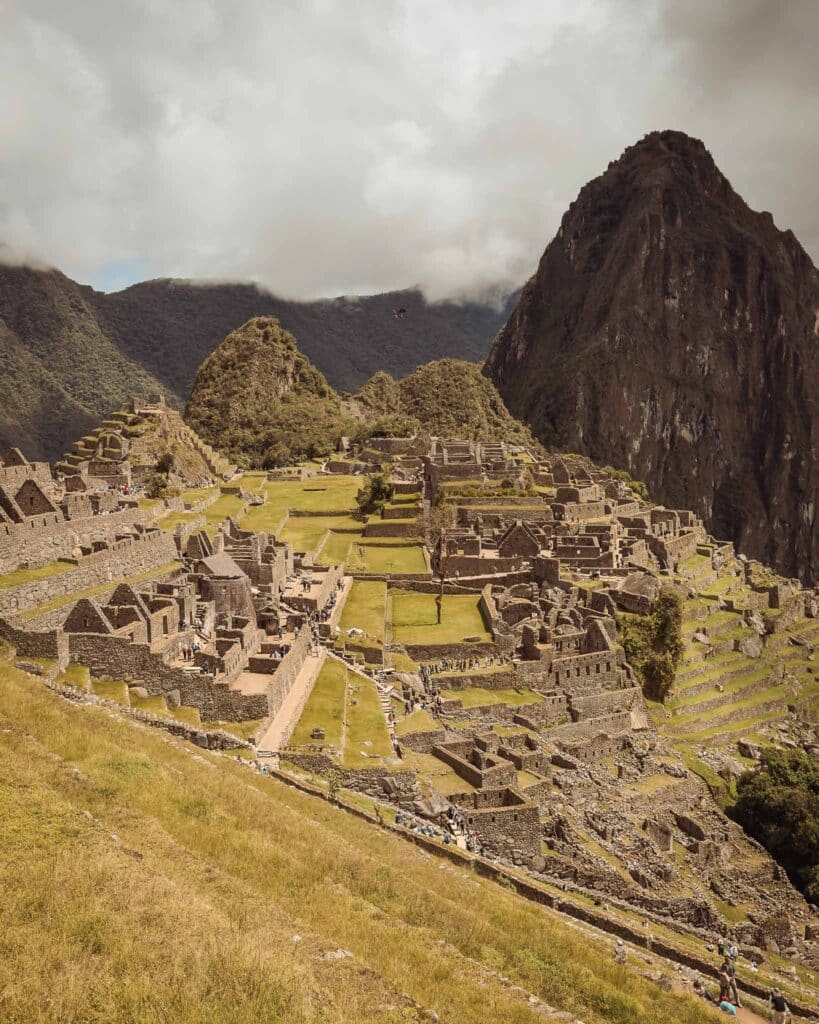
I’ve done this journey firsthand. Cusco to Ollantaytambo by taxi, the scenic train through the Sacred Valley to Aguas Calientes, the bus up the mountain to the entrance, and the full Circuit 2-A with a private guide we found in town. I’ve navigated the in-person ticket system, waited for our number to be called, and stood at the Guardian’s House viewpoint on a clear morning watching clouds drift past the towers.
This is everything you need to know — practically, honestly, and in the right order.
Machu Picchu — At a Glance
📍 Location: Aguas Calientes, Cusco Region, Peru 🚂 Getting There: Cusco → Ollantaytambo → Train → Aguas Calientes → Bus → Machu Picchu ⏱️ Total Journey Time: Approximately 4 hours door to door from Cusco 🎟️ Tickets: Book online at tuboleto.cultura.pe or in person at Aguas Calientes 🗺️ Circuit We Did: Circuit 2-A 📅 Best Time to Visit: Shoulder season — March-April or September-October 👟 Fitness Level Required: Moderate — comfortable walking shoes essential 🧭 Guide: Private guide hired in Aguas Calientes town
Table of contents
- Step 1: Getting from Cusco to Ollantaytambo
- Step 2: The Scenic Train to Aguas Calientes
- Step 3: Arriving in Aguas Calientes — Do This First
- Step 4: How to Buy Machu Picchu Tickets in Person
- Step 5: The Bus Up to Machu Picchu
- Step 6: Should You Hire a Guide?
- Step 7: Circuit 2-A — What to Expect
- Understanding the Machu Picchu Circuit System — 2026 Update
- Quick recommendation guide to choose the Machu Picchu Circuit
- Shoulder Season vs Peak Season for Machu Picchu
- Practical Machu Picchu Tips
- Final Thoughts — Is Machu Picchu Worth the Logistics?
- How to Get to Machu Picchu from Cusco: Your Most Asked Questions (FAQ)
Step 1: Getting from Cusco to Ollantaytambo
The train to Aguas Calientes doesn’t depart from Cusco directly — it departs from Ollantaytambo, a town in the Sacred Valley approximately 1.5 hours from Cusco by taxi or shared transfer.
We took a taxi from Cusco to Ollantaytambo — a straightforward and comfortable journey through the Sacred Valley with views that set the tone for everything that follows. The road winds through open Andean landscape, past local villages and agricultural terraces, and Ollantaytambo itself is worth a brief explore if you arrive with time to spare — it has its own impressive Inca ruins right in the town centre.
Practical tips:
- Book your taxi or transfer in advance through your hotel or hostel — they’ll know reliable drivers
- Allow at least 1.5 hours for the journey and add buffer time if you have an early train departure
- Ollantaytambo has basic cafes and a small market near the train station if you need to grab something before boarding
Step 2: The Scenic Train to Aguas Calientes
The train journey from Ollantaytambo to Aguas Calientes is one of the most beautiful rail journeys I’ve taken anywhere — and I say that as someone who has taken some genuinely beautiful train journeys.
The route descends through the Sacred Valley as the landscape transforms dramatically — open Andean highlands giving way to dense cloud forest, the Urubamba River running alongside the tracks, mist clinging to the mountains above. The valley narrows as you descend and by the time you arrive in Aguas Calientes you feel like you’ve traveled to a completely different world.
We were in a premium cabin with panoramic windows including overhead glass panels that let you watch the mountains rise around you. We ordered chips and chocolate — water was complimentary — and spent the journey chatting and watching the scenery. The ride is comfortable, the views are extraordinary, and the approximately 1.5 hour journey feels genuinely enjoyable rather than just logistical.
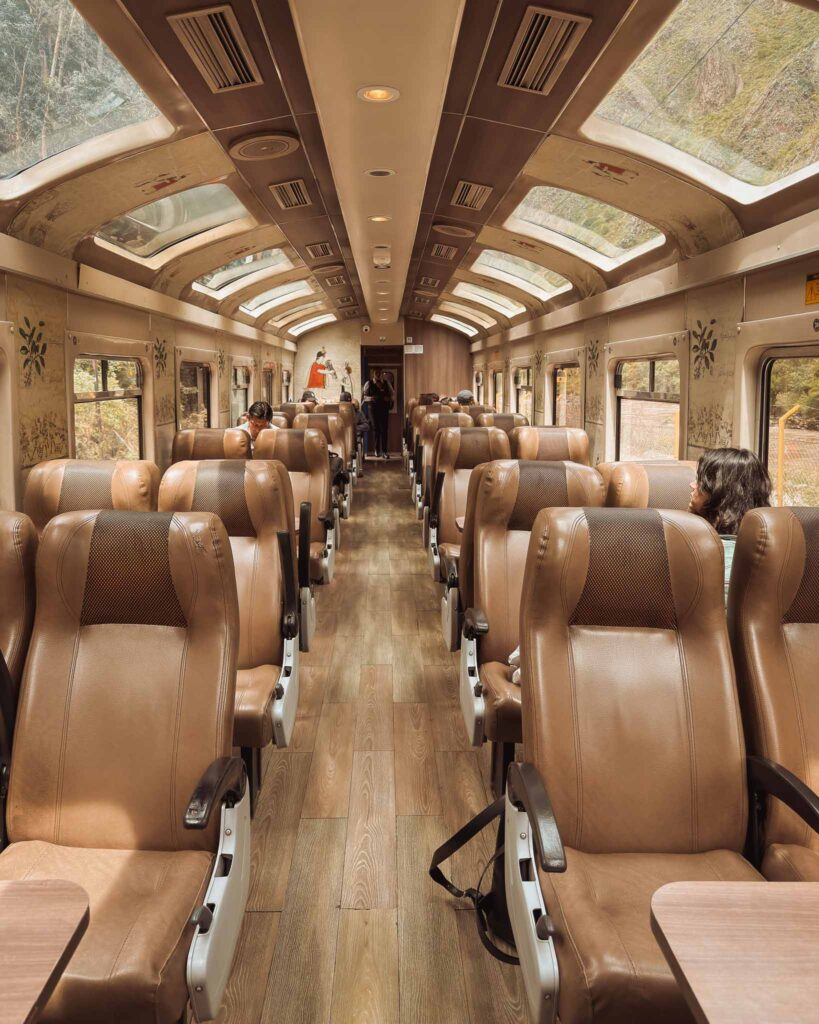
Train options: Peru Rail and Inca Rail both operate this route with several cabin classes ranging from basic to luxury. The panoramic or vistadome carriages are worth the upgrade for the overhead windows — the views upward into the valley walls are something you can’t see from a standard window.
Book in advance. Train tickets sell out weeks ahead in peak season and frequently in shoulder season too. Book through Peru Rail or Inca Rail directly as soon as your dates are confirmed.
If you bought the ticket online, you can skip Step 3 & Step 4
Step 3: Arriving in Aguas Calientes — Do This First
The moment you arrive in Aguas Calientes, before you check into your hotel, before you explore the town, before you do anything else — go straight to the ticket counter and get your queue number.
This is the single most important practical tip in this entire guide.
We arrived around 1:30pm, dropped our bags at the hotel reception and immediately headed to the ticket office to secure our place in the queue. You receive a number and are told to return later in the day when your number is called to actually purchase the tickets. We got our number and returned a couple of hours later to complete the purchase.
If you delay this — if you check in, unpack, have lunch, explore the market — you risk losing your place in the queue for that day’s in-person ticket release. In shoulder season we managed comfortably arriving at 1:30pm. In peak season, arriving earlier is strongly advisable.
Aguas Calientes is a small, walkable town and everything is close — the ticket office, the hotels, the restaurants, the bus stop. Once your queue number is secured you have time to explore, eat, and rest before returning for your tickets.
Step 4: How to Buy Machu Picchu Tickets in Person
If you’ve arrived at this guide because online tickets are sold out — take a breath. There is a solution and we’ve done it firsthand.
The Peruvian Ministry of Culture reserves approximately 1,000 tickets per day specifically for in-person purchase at the ticket office in Aguas Calientes. These tickets are not available online — they exist precisely for situations like yours.
Here’s exactly how the process works:
- Arrive at the ticket office in Aguas Calientes — we recommend arriving by early-to-mid afternoon the day before your intended visit
- Get your queue number — this secures your place in the system
- Return when your number is called — typically a couple of hours later
- Purchase your tickets — have your passport, credit card, and preferred entry time ready
- Download or print your confirmation — you’ll need this at the entrance the following morning
Entry time slots matter. When purchasing in person, select your entry time carefully based on your plan for the day. Earlier slots — 6am-8am — give you the best light for photography and the thinnest crowds before tour groups arrive.
Online tickets: If you’re planning ahead and online tickets are available, book through tuboleto.cultura.pe as early as possible. Daily capacity is strictly limited and popular time slots sell out weeks in advance, particularly in high season.
👉 Book your (online tickets with bus & guide) Machu Picchu Done for you Tickets here. Easiest option but book ahead and skip the lines!
Step 5: The Bus Up to Machu Picchu
From Aguas Calientes, a bus service runs directly up the mountain to the Machu Picchu entrance — a winding 20-30 minute journey on a road that gives you your first glimpses of the cloud forest surrounding the site.
Buses run frequently from early morning — the first departures align with the earliest entry slots. The bus stop is centrally located in Aguas Calientes and easy to find. Buy your bus ticket in advance at the bus office in town rather than queuing on the morning of your visit.
The bus ride itself is atmospheric — as you climb higher the vegetation thickens, the mist appears, and the anticipation builds in a way that feels completely earned by the time the entrance gates come into view.
Step 6: Should You Hire a Guide?
A guide is not strictly mandatory for entry to Machu Picchu — but based on our experience, hiring one transformed the visit from impressive to genuinely extraordinary.
We found our private guide in Aguas Calientes the afternoon before our visit — ask at your hotel, check the town’s main square, or look for licensed guides near the bus stop area. Licensed guides wear official identification and are knowledgeable, personable, and worth every sol.
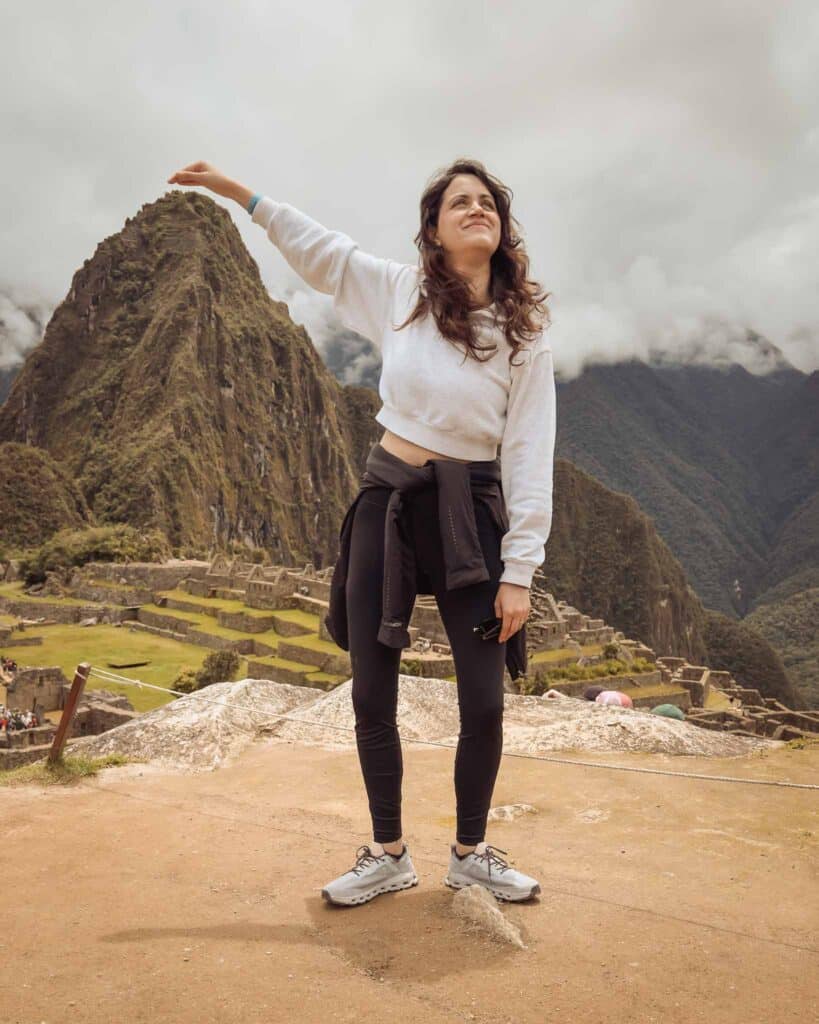
Our guide met us at the entrance, navigated us through the entry lines, and led us through Circuit 2-A with a depth of knowledge and enthusiasm that no amount of pre-reading could have replicated. He explained the history and geography of each section, pointed out birds native to the cloud forest, shared stories about Inca construction and astronomical alignment, and yes — helped us pose for photos with varying degrees of success and much laughter.
Private vs group guide for Machu Picchu. Which one to choose?
A private guide gives you completely personalised pacing and attention — you stop when you want, ask questions freely, and never feel rushed by a larger group’s schedule. Group tours are more affordable and still excellent. For Circuit 2-A specifically, where the one-way system means you cannot backtrack, having a guide who knows the route is particularly valuable.
Step 7: Circuit 2-A — What to Expect
Circuit 2 is the classic Machu Picchu experience — the route that takes you to the most iconic viewpoints and through the most significant sections of the ancient citadel. In 2026, Circuit 2 is divided into two sub-routes:
Circuit 2-A — the more comprehensive route through the urban sector, taking you to the Guardian’s House for the postcard panoramic view, through the agricultural terraces, the residential and temple zones, and the classic sections most associated with Machu Picchu photography.
Circuit 2-B — a shorter alternative covering the lower terraces, still reaching the Guardian’s House viewpoint but with less exploration of the urban sector.
We did Circuit 2-A and it is the one I’d recommend for a first visit — it gives you the fullest picture of the site. That said, experienced guides often navigate fluidly between elements of both routes based on crowd conditions and timing — ours did exactly this, which felt like an advantage of the private guide experience.
The one-way system is strictly enforced — you cannot backtrack on any circuit. This makes a guide particularly valuable as you won’t miss key sections by accidentally taking the wrong path.
The Guardian’s House viewpoint is the moment most people come for — the elevated position looking back over the full citadel with Huayna Picchu mountain rising behind it. Allow time here. Take your photos. Sit with it for a moment. It is as extraordinary in person as every photograph suggests.
Duration: The full Circuit 2-A with a guide takes approximately 3 hours at a comfortable pace.
👉 If you are looking for the tickets, tour guide and bus tickets, all inclusive deal. Book your Machu Picchu Done for you Tickets here!
Understanding the Machu Picchu Circuit System — 2026 Update
When I visited in 2025 there were already designated circuits in place — but the system has evolved and it’s worth understanding clearly before you book your tickets because choosing the wrong circuit means missing sections you wanted to see.
As of 2026 there are three official circuits each covering different parts of the site.
- Circuit 1 focuses on upper terrace panoramic views and includes optional side hikes like Machu Picchu Mountain and the Sun Gate.
- Circuit 2 is considered the most complete route, offering the classic postcard view from the upper terraces plus access to most of the main archaeological areas.
- Circuit 3 focuses exclusively on the lower section of the citadel and is the only route that pairs with Huayna Picchu mountain.
Here’s a quick breakdown of all three to help you choose:
Circuit 1 — The Panoramic Circuit (4 routes)
Best for travelers who want sweeping elevated views or plan to hike one of the mountains. Circuit 1 is the only way to hike Machu Picchu Mountain — a challenging 3-4 hour round trip hike to the summit. It also includes seasonal routes to the Sun Gate (Inti Punku) and the Inca Bridge. Important note: Circuit 1 does not include access to the lower ceremonial areas or major structures like the Sacred Plaza or the Main Temple.
- 1-A — Machu Picchu Mountain hike (most strenuous, 3-4 hours)
- 1-B — Upper terrace panoramic views, shortest Circuit 1 option
- 1-C — Sun Gate trail (seasonal)
- 1-D — Inca Bridge trail (seasonal)
Circuit 2 — The Classic Circuit (2 routes) ✅ We Did This
Circuit 2 offers visitors the classic postcard view from the upper terraces and allows access to most of the main archaeological areas within the citadel — the best balance between scenic viewpoints and historical landmarks for a first visit.
- 2-A — The most comprehensive route through the full urban sector including the Guardian’s House, temples, plazas and the Sacred Rock. Covers approximately 90% of the citadel. Duration: 3 hours.
- 2-B — A shorter alternative still reaching the Guardian’s House viewpoint but with less exploration of the urban sector.
Our experience: We did Circuit 2-A with a private guide who navigated fluidly between elements of both 2-A and 2-B routes based on crowd conditions — one of the advantages of a private guide over a group tour.
Circuit 3 — The Royalty Circuit (routes vary)
Circuit 3 focuses on the lower part of the citadel including the Sun Temple and House of the Inca. It does not include access to the upper terrace for the classic panoramic photo. However it is the favorite of adventurers because it is the only way to access Huayna Picchu mountain.
- 3-A — Huayna Picchu Mountain (most coveted, strictly limited slots, age 18+)
- 3-B — Huchuy Picchu Mountain (shorter, more accessible hike)
- 3-C — Great Cavern adventure route
Important: If you deviate from your authorized circuit, park rangers have the authority to remove you from the citadel — and this may include your guide, leading to cancellation of your entry.
Quick recommendation guide to choose the Machu Picchu Circuit
| Your Priority | Best Circuit |
|---|---|
| Classic postcard photo + full citadel exploration | Circuit 2-A ✅ |
| Panoramic views + mountain hike | Circuit 1-A or 1-B |
| Huayna Picchu mountain climb | Circuit 3-A |
| Shorter visit, still get the classic view | Circuit 2-B or 1-B |
| Inca Trail arrivals | Circuit 3 (mandatory) |
Shoulder Season vs Peak Season for Machu Picchu
We visited in March-April — shoulder season — and it shaped the experience significantly.
Shoulder season advantages:
- Daily visitor capacity drops from peak season levels making the site noticeably less crowded
- In-person ticket availability at Aguas Calientes is more manageable — we secured tickets comfortably arriving at 1:30pm
- The site feels more spacious and the classic viewpoints are easier to photograph without crowds
- Weather in March-April can include some rain — pack a light waterproof layer — but we had clear conditions and the towers were fully visible throughout
Peak season (June-August):
- Maximum visitor capacity in effect — the site is significantly busier
- Online tickets sell out much further in advance
- In-person ticket queues in Aguas Calientes start earlier and are longer — arriving by midday or earlier is advisable
- Weather is generally drier and more reliable
If flexibility exists in your schedule, shoulder season — March-April or September-October — is the sweet spot for Machu Picchu.
Practical Machu Picchu Tips
The 30-Minute Grace Period Entry time slots are strictly enforced. If your ticket says 9:00am, you must enter by 9:30am — arriving after that window risks being denied entry regardless of your ticket. Our guide confirmed this at the entrance. Plan your bus timing accordingly and build in buffer.
What to Wear and Bring
- Comfortable walking shoes with grip — the stone paths can be slippery especially in morning mist
- Light waterproof layer — cloud forest weather changes quickly
- Sunscreen — UV intensity at altitude is significant even on overcast days
- Water bottle — stay hydrated throughout the 3-hour circuit
- Your passport — required for entry alongside your ticket
Photography: The best light at Machu Picchu is early morning — the golden hour glow over the citadel and the mist in the valleys below is extraordinary. The earliest entry slots give you this light before tour groups arrive and the site fills up.
Food and Drink: Food is not available inside the site. Make sure you eat a proper breakfast in Aguas Calientes before your bus departure. There is a restaurant at the entrance area outside the main gate but inside the site itself there is nothing. Bring water and a snack.
Altitude: Machu Picchu sits at approximately 2,430 metres. It is lower than Cusco — so altitude sickness is less of a concern here than at Rainbow Mountain or the high-altitude lagoons. However if you’ve come directly from high altitude Cusco, give your body a day to adjust before attempting strenuous activity.
Read More Articles!
Final Thoughts — Is Machu Picchu Worth the Logistics?
Every single step of it.
The journey itself — the Sacred Valley taxi ride, the panoramic train through the cloud forest, the winding bus up the mountain — is part of the experience in a way that a helicopter transfer never could be. By the time you walk through the entrance gates you’ve earned the view. And the view delivers completely.
The ticket system requires planning and a willingness to be flexible. The in-person option in Aguas Calientes exists and works — we’re proof of that. Go in prepared, get your queue number the moment you arrive, and trust that the logistics will sort themselves out.
What waits at the top is worth every bit of the effort to get there.
👉 Book your (online tickets with bus & guide) Machu Picchu Done for you Tickets here. Easiest option but book ahead and skip the lines!
Let’s Chat!
Have you been to Machu Picchu or is it on your bucket list? Did you book online or navigate the in-person ticket system like us? And would you hire a private guide or join a group tour? Drop a comment below — I’d love to hear from you. Save this guide for your trip planning and share it with someone who needs Machu Picchu in their life. 🦙
How to Get to Machu Picchu from Cusco: Your Most Asked Questions (FAQ)
Yes — and we did exactly this. The Peruvian Ministry of Culture reserves approximately 1,000 tickets per day for in-person purchase at the ticket office in Aguas Calientes. These are not available online and exist specifically for travelers whose online tickets sold out. Arrive in Aguas Calientes by early-to-mid afternoon the day before your visit, get your queue number immediately, and return when called to purchase. We arrived around 1:30pm in shoulder season and secured our tickets comfortably.
Circuit 2-A is the gold standard for first-time visitors — it takes you to the Guardian’s House for the iconic panoramic view of the full citadel with Huayna Picchu mountain rising behind it. Circuit 2-B covers a shorter alternative route but still reaches the same viewpoint. Both fall under the Circuit 2 designation and experienced guides often navigate fluidly between elements of both routes depending on crowd conditions.
Approximately 4 hours door to door. The journey breaks down as follows — taxi from Cusco to Ollantaytambo (approximately 1.5 hours), scenic train from Ollantaytambo to Aguas Calientes (approximately 1.5 hours), and bus from Aguas Calientes up to the Machu Picchu entrance (20-30 minutes). Factor in waiting time at each connection and plan accordingly.
A guide is not mandatory for entry but is strongly recommended — particularly for Circuit 2-A where the strict one-way system means you cannot backtrack if you take a wrong turn. More importantly, the historical and cultural context a good guide provides transforms the experience entirely. We hired a private guide in Aguas Calientes the afternoon before our visit and it was one of the best decisions of the trip. Look for licensed guides in town — they wear official identification and can be arranged through your hotel or found near the bus stop area.