
Estimated reading time: 13 minutes
I visited Vinicunca Rainbow Mountain from Cusco in March-April during shoulder season — this guide is based entirely on our firsthand ATV experience at over 5,000 metres above sea level.
Rainbow Mountain is one of those places that looks completely impossible in photos — vivid stripes of red, yellow, green and purple running across a mountain peak in the Peruvian Andes like something painted by a very confident artist. And then you arrive and realize the photos actually undersell it.
But getting there requires a decision most travelers agonize over before booking: do you hike the traditional route or take an ATV? We chose the ATV. And it was one of the best decisions of the entire Peru trip.
This is your complete, honest comparison of both options — what each involves, who each is right for, and everything you need to know before you book your Rainbow Mountain tour from Cusco.
This post contains affiliate links, which means I may earn a small commission at no extra cost to you.
Rainbow Mountain — At a Glance
📍 Location: Vinicunca, Cusco Region, Peru 🏔️ Altitude: 5,200 metres (17,060 feet) above sea level 🚐 Getting There: Tour from Cusco — approximately 4 hours each way 🏍️ ATV Cost: Approximately $60 USD per person including buffet lunch 📅 Best Time to Visit: Shoulder season — March-April or September-October ⏰ Departure Time: Early morning from Cusco — around 4:00-4:30am 🦙 Wildlife: Llamas and alpacas at the summit 📖 Passport Stamp: Available at the summit — read our caution below
Table of contents
- Rainbow Mountain — At a Glance
- Why Rainbow Mountain Requires a Decision
- The ATV Option — Our Firsthand Experience
- The Traditional Hike — What to Expect
- ATV vs Hiking — Side by Side Comparison
- The Tour From Cusco — What’s Included!
- Food Along the Way — What to Expect
- Altitude and How to Handle It
- The Passport Stamp — Worth It But Read This First
- The Red Valley Add-On
- Practical Rainbow Mountain Tips
- Final Thoughts — Which Should You Choose?
- Rainbow Mountain ATV vs Hiking: Your Most Asked Questions (FAQ)
Why Rainbow Mountain Requires a Decision
Rainbow Mountain sits at 5,200 metres above sea level — higher than almost anywhere most North American travelers have ever been. The traditional hike from the base covers roughly 8 kilometres round trip at extreme altitude, gaining significant elevation on the way up. For travelers with limited hiking experience, altitude sensitivity, or simply limited time, this is a genuinely daunting prospect.
The ATV option changes the equation entirely. Instead of hiking the full route, you ride an ATV up the mountain trail covering most of the elevation, then walk a short final section to the summit. It’s faster, less physically demanding, and — based on our experience — genuinely thrilling in its own right.
Neither option is wrong. They’re just different experiences for different travelers. Here’s everything you need to know about both.
The ATV Option — Our Firsthand Experience
We chose ATVs and I will not be apologizing for it.
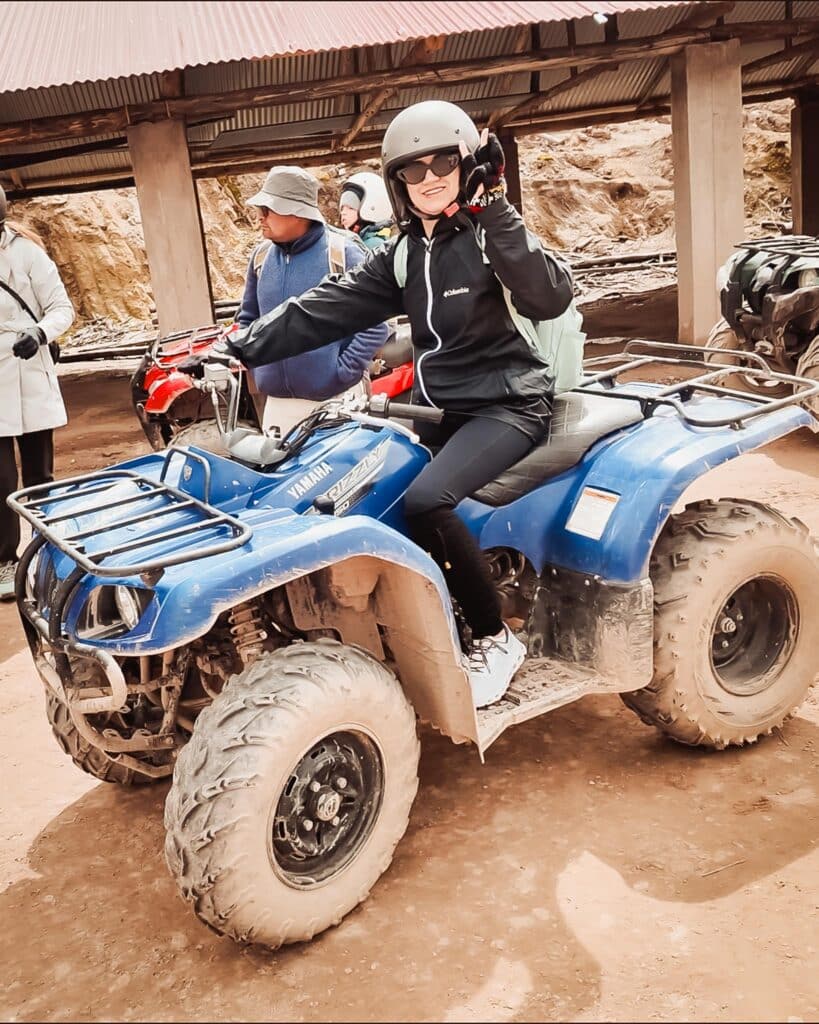
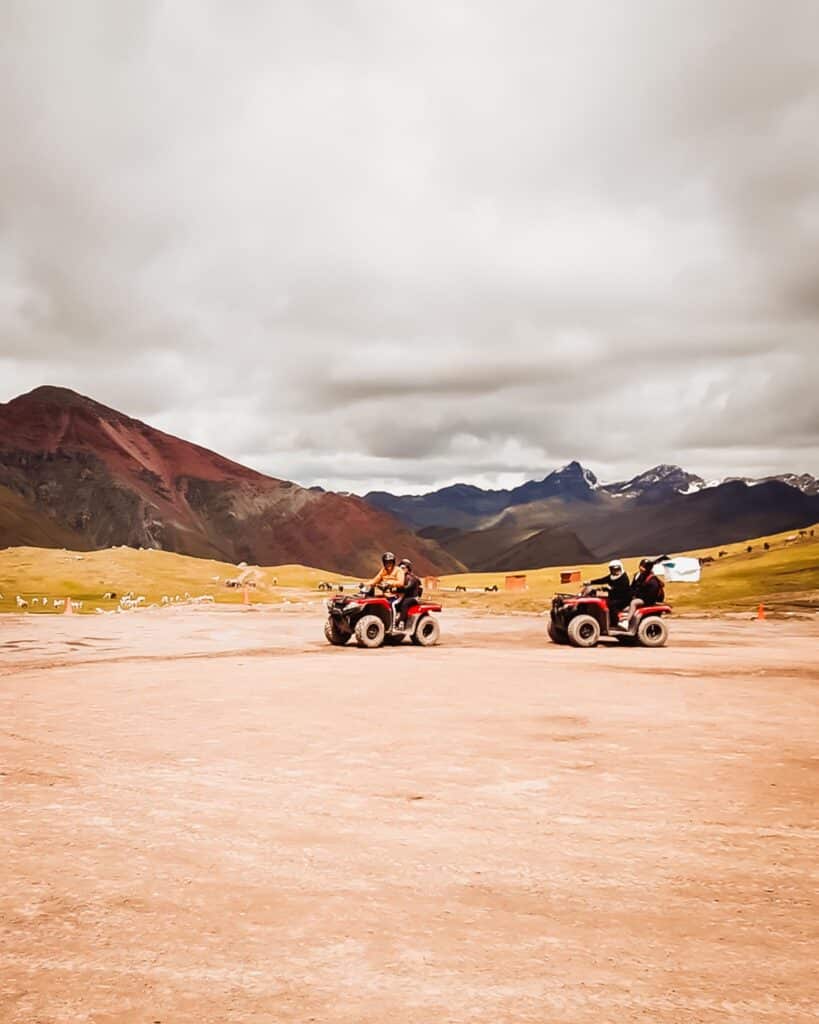
After arriving at the ATV base following the tour’s buffet lunch stop, we were each assigned an ATV and given a brief orientation. Self-driving the ATV up the mountain trail — at 5,000 metres, with the Andean landscape stretching in every direction — was genuinely one of the most exhilarating experiences of the whole Peru trip. The trail winds up through the high-altitude terrain with views that expand dramatically as you climb.
The ATV takes you most of the way up — roughly 90% of the elevation. From where you park the ATVs it is approximately a 5-minute walk to the summit of Rainbow Mountain. At 5,200 metres that 5 minutes feels more significant than it sounds — take it slowly, breathe steadily, and don’t rush. But it is completely manageable even for travelers who aren’t regular hikers.
And then you reach the top. The rainbow-striped mineral ridges of Vinicunca spread out in front of you — vivid, surreal, and exactly as extraordinary as every photo suggests. Llamas and alpacas graze nearby completely unbothered by the humans gaping at the landscape around them. It’s one of those places where you stand there for a while saying very little because nothing you say quite covers it.
Who the ATV option is best for:
- Travelers concerned about altitude or fitness levels
- Anyone who wants to maximize time at the summit rather than the journey up
- Adventure-seekers who want to add an extra thrill to the experience
- Travelers with limited time who still want the full Rainbow Mountain experience
The Traditional Hike — What to Expect
The traditional hike to Rainbow Mountain is a serious undertaking at serious altitude — and for the right traveler, it is the more rewarding way to arrive.
The hike covers approximately 8 kilometres round trip from the trailhead, with a gradual but sustained ascent to the 5,200 metre summit. At sea level this would be a moderately challenging hike. At 5,200 metres with significantly reduced oxygen, it becomes considerably more demanding. Most hikers take 2-3 hours to reach the summit and the same to return.
The payoff of hiking is the journey itself — the high-altitude Andean landscape unfolding around you at walking pace, the sense of having earned the summit view, and the deeply satisfying feeling of arriving at Rainbow Mountain on your own two feet.
Who the traditional hike is best for:
- Experienced hikers comfortable at altitude
- Travelers who have properly acclimatized in Cusco for 2+ days
- Anyone who wants the full physical and emotional experience of the ascent
- Travelers who prioritize the journey as much as the destination
ATV vs Hiking — Side by Side Comparison
| Feature | ATV | Traditional Hike |
|---|---|---|
| Effort Level | Low-Moderate | High |
| Time to Summit | ~30-45 mins by ATV + 5 min walk | 2-3 hours |
| Altitude Challenge | Minimal — short final walk | Significant throughout |
| Cost | ~$60 USD including lunch | ~$30-40 USD including lunch |
| Experience Type | Adventurous, thrilling | Physical, meditative |
| Best For | Most travelers | Experienced hikers |
| Views on the Way Up | Excellent from ATV | Excellent on foot |
| Summit Experience | Identical for both | Identical for both |
| Fitness Required | Basic | Good to excellent |
| Altitude Sickness Risk | Lower | Higher |
Bottom line: The summit experience is identical regardless of how you get there. The difference is entirely in the journey up — and which version of that journey appeals to you.
The Tour From Cusco — What’s Included!
Rainbow Mountain is not accessible independently for most travelers — the distance and logistics make a guided tour from Cusco the practical standard. Tours depart from Cusco’s Plaza de Armas in the early hours of the morning and include transport, the buffet lunch, and entry to the mountain.
The early departure is not optional. Tours leave around 4:00-4:30am from Cusco and this timing has become even more important in 2026 as authorities now more strictly manage arrival windows to stagger crowds and reduce mid-day fog on the mountain. Arriving early gives you clearer skies, better light for photography, and a less crowded summit. If your tour offers a later departure, think twice.
What’s typically included:
- Return transport from Cusco (approximately 4 hours each way)
- Buffet lunch at a designated stop on the route
- ATV rental if you choose that option
- Entry to Rainbow Mountain
What’s not always included:
- The passport stamp at the summit (small additional fee)
- Gloves — our tour required them and we had to purchase a pair at the base since we hadn’t brought any. Pack your own to avoid this.
- Tips for your guide and ATV staff
👉 Book your ATV Rainbow Mountain tour here!
Food Along the Way — What to Expect
One of the most unexpectedly delightful parts of the Rainbow Mountain tour was the food — and I say that as someone who had fairly low expectations for a long-haul tour day.
The roadside bread stop: On the way to the mountain our tour stopped at a roadside vendor where freshly baked bread was available to purchase. We grabbed one and ate it warm in the minivan. At that hour of the morning, fresh bread straight from a traditional oven is exactly what you need. It was delicious — simple, warm, and one of those small travel moments that sticks with you.
The buffet lunch: The included buffet lunch at a stop along the route was a genuine surprise. Hot food, decent variety, well-maintained. For North American travelers who might feel apprehensive about food safety on a rural tour day — our experience was entirely fine. The food was hot, freshly prepared, and the options were solid.
The coca leaf tea: At the lunch stop our tour also provided fresh coca leaves to add to hot water as tea — a traditional Andean remedy for altitude sickness that is widely used across the region. We had also picked up coca leaf candy from a vendor at Plaza de Armas in Cusco before the trip. Both helped noticeably with the altitude. More on this in the altitude section below.
Altitude and How to Handle It
Rainbow Mountain at 5,200 metres is not to be underestimated — even for travelers who consider themselves reasonably fit.
We had spent half a day in Cusco (3,400 metres) before the Rainbow Mountain tour which provided some acclimatization. I also grew up in a mountainous region which helps with altitude tolerance. Even so, the final walk to the summit at 5,200 metres felt noticeably heavier than normal — slightly breathless, slightly slower than usual. Nothing alarming, but the altitude makes itself known.
What genuinely helped us:
- Coca leaf candy — available from vendors at Plaza de Armas in Cusco. Pick some up the day before your tour. They are widely used by locals and visitors alike for altitude acclimatization and made a real difference for us.
- Coca leaf tea — provided at the lunch stop on our tour. Sip it slowly and let it work.
- Slow and steady movement — at 5,200 metres there is no rushing. Walk the final section to the summit slowly, breathe deliberately, and stop whenever you need to. The mountain isn’t going anywhere.
- Hydration — drink water consistently throughout the day, starting the night before your tour.
Who should be most cautious: Travelers flying directly from sea level to Cusco and attempting Rainbow Mountain the next day are taking a significant altitude risk. Give yourself at least one full day in Cusco before the tour — two days is better. If you experience severe headaches, nausea or disorientation, descend immediately and seek medical attention.
The Passport Stamp — Worth It But Read This First
At the Rainbow Mountain summit there is a small station where you can get a stamp — a fun souvenir marking your visit to Vinicunca. There is a small fee of a few dollars. We got ours and it felt like a lovely memento of the experience.
Important caution: Some countries’ immigration authorities have been known to flag or question passports with unofficial tourism stamps — in rare cases treating them as potential document tampering. While this is uncommon, it is worth knowing before you press an unofficial stamp into your passport.
Our recommendation: If you want the stamp — and it is a fun keepsake — consider carrying a small travel diary, a postcard, or a separate piece of card to get it stamped on instead of your passport. You get the souvenir without any potential immigration complications down the line. Better safe than sorry on a document you need to keep in perfect condition.
The Red Valley Add-On
The Red Valley — Valle Rojo — is a dramatic rust-coloured valley adjacent to Rainbow Mountain that has become increasingly popular as an add-on to the standard Rainbow Mountain visit.
We did not do the Red Valley on our tour — our visit was focused purely on Vinicunca. However in 2026 many tour operators now offer a combined Rainbow Mountain and Red Valley loop as a single experience, and it is the most requested add-on for North American travelers currently. If the full landscape experience appeals to you, look for tours that specifically include the Red Valley circuit when booking — it adds time to the day but the visual contrast between the rainbow stripes of Vinicunca and the vivid red of the adjacent valley is reportedly spectacular.
👉 Book your ATV Rainbow Mountain tour here!
Practical Rainbow Mountain Tips
Book your tour in advance Rainbow Mountain tours from Cusco fill up quickly — particularly in peak season and around popular shoulder season windows. Book through a reputable operator or platforms like Get Your Guide before you arrive in Cusco rather than hoping for walk-in availability.
Bring gloves — don’t buy them at the base Our tour required gloves and we hadn’t packed any — we had to purchase a pair at the base at an inflated price. Pack your own before the tour and save yourself the expense and hassle.
Dress in layers The early morning departure means cold temperatures at the start of the day. By the time you reach the mountain the physical activity and mid-morning sun warm things up. Layers you can add and remove as needed are essential.
Acclimatize properly in Cusco first At minimum spend half a day in Cusco before attempting Rainbow Mountain. One full day is better, two is ideal. Your body needs time to adjust to the altitude before you push it to 5,200 metres.
Download offline maps Cell service is unreliable or nonexistent for most of the Rainbow Mountain route. Download offline maps before departing Cusco.
Carry a postcard or diary for the stamp If you want the Rainbow Mountain summit stamp — and it’s a lovely souvenir — bring something other than your passport to stamp it on. See our caution above.
Shoulder season advantages We visited in March-April and found the mountain noticeably less crowded than peak season reports suggest. The weather was clear and visibility was excellent. Shoulder season — March-April and September-October — is genuinely the sweet spot for Rainbow Mountain.
Read More From Peru!
Final Thoughts — Which Should You Choose?
If you are physically fit, well acclimatized, and want the full meditative experience of arriving at a 5,200 metre summit on foot — hike it. The traditional route is genuinely rewarding and the sense of having earned the view is real.
If you have any concerns about altitude, fitness, or simply want to spend more time at the summit and less time getting there — take the ATV. It is not the easy option in some diminished sense — riding an ATV up a mountain at 5,000 metres is its own kind of extraordinary. And the summit experience when you get there is identical.
We chose the ATV and we would choose it again without hesitation. The 4am alarm, the fresh bread in the dark, the coca leaf tea, the ATV climbing higher and higher through the Andes, the llamas at the summit, the rainbow ridges spreading out in front of us — it was a perfect day from start to finish.
Whatever option you choose — Rainbow Mountain will deliver completely.
Let’s Chat!
ATV or hiking — which would you choose for Rainbow Mountain? And would you brave the 4am departure for a view like this? Drop a comment below — I’d love to hear from you. Save this guide for your Peru planning and share it with someone who needs Rainbow Mountain on their list. 🦙
Rainbow Mountain ATV vs Hiking: Your Most Asked Questions (FAQ)
Yes — but only a very short final section. The ATV takes you approximately 90% of the way up the mountain. From where you park the ATVs it is roughly a 5-minute walk to the summit at 5,200 metres. At that altitude even 5 minutes feels more significant than usual — take it slowly and breathe steadily. But it is completely manageable for most travelers regardless of fitness level.
We paid approximately $60 USD per person which included the buffet lunch. Prices vary by operator and season — check current availability and pricing through Get Your Guide for the most up to date options. The traditional hiking tour is typically $30-40 USD including lunch. The ATV premium is well worth it in our opinion.
Yes — Rainbow Mountain sits at 5,200 metres above sea level and altitude sickness is a real consideration. We experienced mild heaviness and breathlessness at the summit despite having spent time in Cusco beforehand. Coca leaf candy from Plaza de Armas in Cusco and coca leaf tea at the lunch stop helped significantly. Acclimatize properly in Cusco for at least one full day before attempting the mountain and ascend slowly at all times.
Yes — there is a small station at the summit offering a commemorative stamp for a few dollars. It’s a fun souvenir but we strongly recommend stamping a travel diary, postcard or separate card rather than your passport. Some immigration authorities have questioned unofficial tourism stamps in passports — it’s a rare issue but not worth the risk on a document you need in perfect condition.


Hi! I also viewed your youtube, thanks for responding there as well. When I try to click your link to book the ATV Tour it shows all the different ATV tours from Get your Guide but not a specific one. Do you mind sending me the exact tour operator you booked? thank you!
Hey Ray, thank you. Yes get your guide tends to show you other options too. When you click on the link you will see one of the tours highlighted that is the one you need to book. I am happy to send you a screenshot if you send me a DM on Instagram.